
By Sebastian Kaczmarczyk, Chief Product Officer
We recently released AI agents for high-stakes work, our whitepaper on what we learned building agents at Hermes Intelligence. One question behind it deserves more attention: how much work does an answer leave you before you can use it?
LLMs often give you something that sounds like an answer. The facts may be correct, the sentences clear, and the conclusion reasonable. Yet a detail that changes the decision can still be missing.
For a team using intelligence to assess a supplier or protect a delivery schedule, that is a serious problem. They need to understand what the information means for their business, including the facts that complicate the first conclusion.
That is the standard we are working towards with Vextrum.
A clear screening result can leave the question open
In our Egypt demonstration workspace, we asked:
What does our workspace show about Delta Steel & Rebar Trading Co. and its owners, and why should Aurelia’s procurement team care?
The companies and scenario data in this example are fictional. The question was run through Vextrum’s Deep mode.
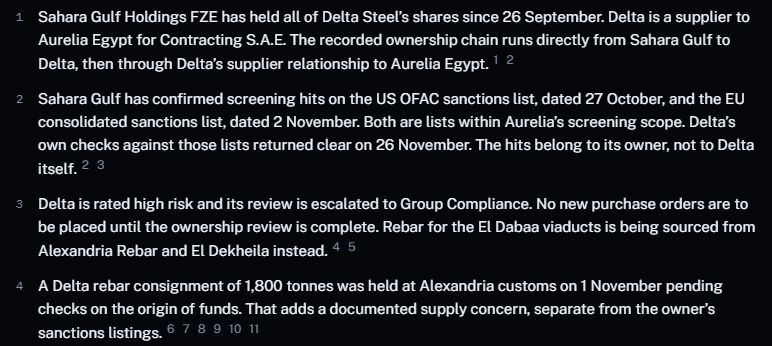
Delta Steel’s own sanctions screenings were clear. Taken alone, that result could leave a reader with the impression that there was little to investigate. The ownership records changed the picture: Delta’s sole recorded owner, Sahara Gulf Holdings, had confirmed US and EU sanctions hits.
The workspace also held an internal procurement note. It instructed the team to place no new orders with Delta until the ownership review was complete and recorded that replacement rebar was being sourced for the El Dabaa viaducts.
Vextrum’s answer brought those records together. Its opening preserved the condition that mattered: new purchase orders were frozen pending compliance review. It then explained the ownership link, distinguished the supplier’s screening results from the owner’s listings, and connected the issue to procurement for the works.
The difficulty here is that each record answers a different question. Screening describes a named entity. Ownership connects that entity to another. The procurement note records a decision and the condition attached to it. Finding passages that mention Delta is only the beginning. The assessment depends on following those relationships and preserving what each record can actually establish.
A response could accurately cite Delta’s clear screening and still leave the procurement team with an incomplete assessment. Every sentence might have support, while the answer omits the ownership exposure that changes its meaning. That is why we need to examine both the support for a conclusion and the evidence that could qualify or overturn it.
The wording is part of the analysis
There is a practical difference between “purchase orders are frozen” and “new purchase orders are frozen pending compliance review”. One leaves the reader to work out the scope and duration. The other carries the restriction into the conclusion.
The distinction between a supplier and its owner matters just as much. A listing against the owner, a clear screening result for the supplier and a decision to stop new orders are separate facts. An answer has to explain their relationship without treating them as interchangeable.
In this example, Vextrum also stated what the records did not establish: whether a customs-held consignment had been released, when the ownership review would conclude, and the legal effect of the owner’s listings on a particular transaction.
Those qualifications help the reader understand where the recorded facts end and further work begins. They should be visible in the answer, close to the conclusion they affect.
The reader needs a way back to the evidence
A useful conclusion still needs support that someone else can inspect. In the demo answer, the findings linked to evidence receipts, and the procurement note appeared alongside the review record in a table.

That gives the analyst a way to check the wording against the record. They can see what the procurement team instructed, when it was recorded and how it relates to the answer above it.
Published reporting requires the same care with attribution. A source’s words and date help establish what was reported and when. A workspace record needs to be identified as that record. Neither should acquire more authority merely because it appears inside a fluent answer.
The point is to make the assessment reviewable. If a colleague challenges the conclusion, the analyst should be able to return to its basis without reconstructing the whole search.
What the answer leaves the analyst to do
The procurement team still has decisions to make. It needs the outcome of the ownership review, clarity on the relevant transaction and confirmation that replacement supply will meet the programme’s needs.
In this case, Vextrum gave the team a connected assessment: the ownership exposure, the procurement restriction already recorded and the questions that remained unresolved. That lets the analyst direct the next check towards a specific gap instead of assembling the supplier picture again.
This example illustrates one part of the approach described in our whitepaper.
An intelligence answer earns its place in a decision when the person using it can explain the conclusion, defend its basis and recognise when it needs to change.